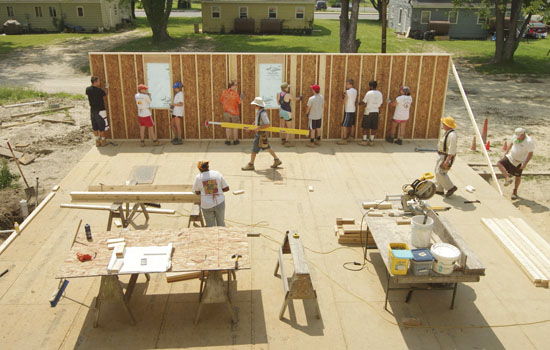
Here is updated look at the construction progress on the West Wind Residence.
Tuesday, February 5, 2013
Thursday, January 17, 2013
West Wind Residence, Yamhill
County, Oregon
This modern ranch house with sweeping views of the wine country is one
of our more recent projects currently under construction. Designed as three
separate structures, two separate master bedroom blocks and one central living
area block, are all connected by a series of high shed roofs and low roof
canopies. With its single level U-shaped plan, this 5000 SF design takes
advantage of its wide site by creating large outdoor living areas within a
central private courtyard.
Pacific Northwest and western influences in materials are Columbia River stone basalt walls and natural cedar at
both interior and exterior planes. The large roof overhangs and lower roof
canopies were designed for better outdoor living in the winters and
simultaneously offering shade during the dry summers.
Friday, January 4, 2013
Friday, December 14, 2012
Maintaining A Smooth Construction Project - “Hot Buttons” To Avoid
The following is a list of the top complaints we receive from our clients. Avoiding these “hot buttons” will result in a happy client and successful project.
1. Job Cleanliness
Over and over again, the top complaint we receive is a dirty, messy job site (building and site). Clients expect a level of quality equal to what they themselves would do when they are doing a home project. You can avoid the mistake of pushing this button by:
- broom sweeping the job daily;
- providing trash containers at each floor for workers’ use in addition to construction dump boxes;
- post a job sign with worker etiquette guidelines that addresses cleanliness along with other items (i.e., start/stop times, parking, smoking, language, radios, pets);
- set an example; if the general is not keeping a clean site, the subs will not. If a sub walks into a messy site, they work the same way;
- proper storing and staging of materials;
- remove the trash and recycling on a timely, regular schedule.
VS.
2. Presence on the Job Site
Whether or not you have an on site, full or part-time, superintendent, clients want to see action on the job site. Nothing is more frustrating to owners than visiting their project and seeing no workers on site.
- create a construction schedule;
- inform clients of schedule changes and delays;
- since there are natural stages of the job when little or no manpower will be evident (drywall mud is setting); let the clients know this in advance so they are not surprised when they see little or no activity.
Clients are paying a lot of money for their construction. Regardless of whether it is a large or small job for your company, it is always a large project for the clients. They are buying the materials and paying you to keep things from getting damaged. A few examples of protection are:
- protect door sills and jambs;
- cover finished work as soon as possible to protect from damage (i.e., jambs and sills, counters, cabinets, floor, door surface);
- be sure proper protection is taken prior painting. Over spray is difficult to remove from many surfaces.
- Be sure that the job is locked up each night.
The best marketing and PR plan you can have is word of mouth. The single most effective way to have a happy client referring you is by finishing the job on time.
- make a schedule: we all know that schedules change, but you cannot attempt to keep a schedule if you don’t have a schedule to start with. A realistic schedule should be developed prior to start of work and reviewed with the client;
- update schedule periodically and review changes with the client;
- let the client know when time will be added or saved on the project. Do not assume the client should understand that the project will take longer just because they may have added something. Unless you tell them, they will not necessarily expect this;
- Change Orders are for changes in scope and time. Be sure to ask for, and explain, the need for additional time. Knowing that something may take longer may effect whether the client decides to follow through on the Change Order.
Communication, Communication, Communication! If location is the key work in real estate, communication is the key word in residential construction. Most clients, while they may not like what you have to tell them, are much happier if they are informed and involved rather than being hit by a surprise later.
- be honest with the client about schedules, delays, problems, etc. Clients, for the most part, understand as long as they are informed. Keep then informed;
- avoid telling the client what you think they want to hear rather than the truth (i.e., do not tell them the painter will be there tomorrow if you have not even scheduled them);
- unfortunately, a few unethical contractors in every city create an environment of distrust of contractor by homeowner. Homeowners have a fear of getting ripped off. Dishonesty feeds this distrust of the profession on a whole.
Communication, again is the key. Changes in scope of work need to be discussed, and approved, prior to the wok being done:
- develop a clear method of processing change orders;
- communicate this process with the owner prior to starting construction;
- follow through on your process. Don’t tell them there will be a written change order that needs to be signed and then not do the paper work before doing the work.
- Do Not assume that the client’s will expect an increase in price if they asked for something and you have done the work;
- avoid having sub-contractor/client changes from occurring without your knowledge or presence;
- if something is going to cost more, get in the habit of saying, “we would be happy to do that, BUT . . .it will add cost to the job and extend the schedule.”
Thursday, October 25, 2012
Design With the Other 90%: Cities
For
the first time in history, most of the world’s seven billion people live in
cities. However, close to one billion of these people live in informal
settlements, crudely referred to as slums or squatter settlements. Many of
these people are forced to live on only 2 dollars a day, and as a result there
are many societal problems that arise. “Design With the Other 90%: Cities” is
an exhibition that helps to solve these issues through design. It is currently
on display in Portland, the only West coast city to host the exhibit. Take a
day to walk to the two display locations and you will see what an expansive
project this is.
Organized
by Cooper-Hewitt National Design Museum, “Exchange, Adapt, Include” can be
viewed at the Museum of Contemporary Craft. A short stroll to the MercyCorps
building and you can see the “Reveal, Prosper, and Access” portion of the
exhibit. Countries in Southeast Asia, South America, and Africa are the primary
focus of the design work. Design professionals from around the globe collaborated
with residents to create a new infrastructure for the poor that fosters and
accelerates innovation.
There are 60 projects, proposals,
and solutions on display at the two venues. Individual objects such as;
portable vendor stands, solar lanterns, and community kitchens help shine the
spotlight on entrepreneurship and innovative approaches to the needs in these
rural communities. There are also broader strategic solutions for farming,
irrigation, urbanization, teaching, and shelters. Each project is displayed
through use of; video and photo documentation, full scale artifacts and models,
and statistical data. The projects are presented beautifully and are visualized
throughout the exhibition to further contextualize the challenges met by the
design solutions. It is an extremely worthwhile way to spend your Saturday.
Thursday, October 11, 2012
Architecture and Design Festival Home Tour
As
part of the 2012 Portland Architecture and Design Festival, the “Design Matters
Home Tour” will be happening this Saturday, October thirteenth, from 10 am on.
Seven innovative homes from top local architects will be open for viewing,
including a prefab home from Jeff Kovel, and several examples of modern,
efficient architecture and living. The tour is all day and it is self-guided,
with tickets available for 40 dollars. Please call (503)223-8757 for ticket
information, and visit the website below for home tour info or other Design
Festival activities.
Portland Open Studios Tour
This
weekend marks the first round of the 2012 “Portland’s Open Studios” tour, which
takes place throughout Portland. This is a unique and fun way for artists from
a variety of disciplines to share their work, process, and spaces, as they open
their doors to the public for viewing. There are over 100 artists who have
applied and been selected by an independent juried panel, who will share their
art the second and third weekends in October. Not only will you be able to view
the artist in their element, art will be available for purchase. A tour guide
($15), or a map-only ticket ($5) can be purchased at any New Seasons, and the
art stores Collage, Muse, Columbia, and I’ve Been Framed. Giulietti/Schouten
Architects also have tickets available.
Subscribe to:
Posts (Atom)